Bruxism: symptoms, causes and treatment
20.10.2026 · 7 min read
Bruxism is involuntary clenching or grinding of the teeth. A person does not control this movement, so relatives or a doctor more often notice the signs during an examination. Here is how to tell bruxism from ordinary tension and what the clinic does.
What bruxism is
Bruxism is repeated activity of the chewing muscles: clenching the jaws or moving the teeth without food. It is not a household habit. Episodes can occur during sleep or in a state of concentration.
Night and awake bruxism are distinguished. The night form is more often accompanied by grinding that others can hear. The awake form - by clenching the jaws while working at a computer or under emotional tension.
The forms can combine. Then a person clenches the teeth during the day and grinds at night.
Night bruxism
It occurs in sleep, often in certain sleep phases. The patient does not remember the episodes. Signs: worn teeth, jaw fatigue in the morning, tension headache.
Awake bruxism
A person clenches the teeth during the day, often unconsciously. Grinding is less typical; there are more complaints of tension in the temples and tight tooth contact.
Why bruxism occurs
The cause of bruxism is multifactorial. Scientific data do not give a single explanation for all cases.
- stress and emotional tension;
- sleep disturbance and breathing problems during sleep;
- features of the bite and occlusion;
- side effects of some medicines prescribed by a doctor;
- heredity and features of nervous regulation.
Occlusion is rarely the only cause. So treatment is not limited to grinding the teeth.
Some medicines can increase jaw clenching. Do not change the dose yourself: the decision is made by the doctor who prescribed the medicine.
Breathing problems during sleep also need attention. If there is snoring or breathing pauses, the doctor refers you for additional examination.
How to recognise bruxism: symptoms
- worn enamel, the teeth have become shorter;
- morning pain in the jaws and temples;
- tension headache;
- increased tooth sensitivity;
- cracks in fillings and chips;
- the sound of grinding at night that relatives can hear;
- tension of the chewing muscles on palpation.
One symptom does not confirm the diagnosis. The doctor assesses the whole set of signs and the condition of the joint.
Relatives often notice more than the patient does. Their observations help the doctor during the conversation.
Why bruxism is dangerous
Constant loading destroys enamel and overloads the periodontium and the joint. Effects: wear, chips, sensitivity, joint pain and muscle fatigue. The degree of risk is individual.
Wear develops gradually. A person gets used to the sensations and comes late, when the changes are already visible.
Fillings, crowns and veneers also take the load. They can chip or lose contact with the tooth.
Bruxism in children and teenagers
In children bruxism is often linked to teething and bite changes. Many cases resolve with age. An examination is needed if there is wear, complaints of pain or chips.
Treatment for a child is chosen carefully. A splint is made only when indicated and after assessing the teeth and gums.
Parents should pay attention to the sound at night and complaints of jaw fatigue in the morning. These simple observations help the doctor.
How bruxism affects the joint
Constant clenching overloads the temporomandibular joint. Clicking, muscle fatigue and pain when chewing are possible. These symptoms do not always mean joint damage.
The doctor assesses the joint separately from the teeth. This affects the treatment plan.
If joint pain is already present, the approach is discussed separately. Sometimes a consultation with a gnathologist or a related specialist is needed.
How bruxism is diagnosed
Diagnosis starts with a conversation and an examination. The doctor checks wear and the gums, palpates the chewing muscles and the joint, and analyses the occlusion.
The doctor also asks about sleep, medication, stress level and previous orthodontic treatment. These data help to draw up a plan.
When indicated, X-rays or a CT scan are prescribed. Polysomnography is rarely needed, usually in complex cases and by referral.
Treatment: what the clinic offers
The goal of treatment is to reduce the load and protect the teeth. Complete elimination of bruxism is not guaranteed.
- an occlusal splint (night guard) - details about the bruxism splint;
- occlusion correction when indicated, including selective grinding;
- orthodontic treatment if the cause is related to the bite - orthodontist and braces;
- follow-up examinations and monitoring;
- referral to related specialists when needed.
A splint does not cure the cause. It protects the teeth and reduces the load on the joint. It is made from impressions, with correction of the occlusal surface.
A check-up is scheduled a few weeks after the splint is issued. Then every 6 months. If the splint is uncomfortable or wear appears, it is adjusted.
The splint must be cleaned and stored separately from the toothbrush. A damaged splint is not used.
What you can do at home
- watch the position of your jaws during the day;
- reduce excessive caffeine intake in the evening;
- relax the muscles before sleep;
- do not chew hard objects;
- attend follow-up examinations.
Home remedies do not replace diagnosis. Self-treatment can cause harm.
If your jaw feels stiff in the morning, try a few minutes of calm breathing before getting up. This does not treat the cause but reduces tension.
Do not expect the problem to pass on its own after a diet change. Chronic loading accumulates over years.
When to see a doctor
See a doctor if you notice wear, morning pain, chipped fillings or the sound of grinding. A consultation is also needed before prosthetics or orthodontic treatment. General prices and the cost of a splint are confirmed after diagnosis.
Bring a list of the medicines you take to the consultation. This helps to assess risk factors.
If the pain has become constant or the jaw locks, do not postpone the visit.
Read about jaw joint pain and clicking in a separate article.
Need a consultation?
Лікарі Sorridi Ірпінь оглянуть і дадуть персональні рекомендації. Форма запису - нижче.
Frequently asked questions
Can bruxism be cured completely?
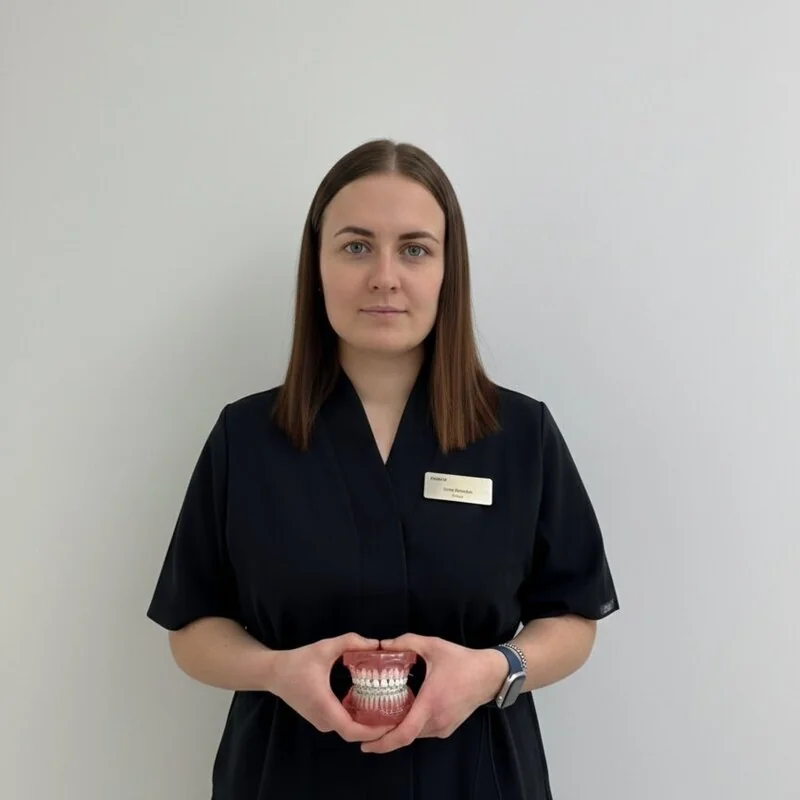
Yuliia Kunets
Orthodontist
Complete elimination cannot be guaranteed. Treatment reduces the load on the teeth and joint, controls symptoms and prevents complications. The result depends on the causes and regular follow-up.
Does a splint harm the teeth?
Yuliia Kunets
Orthodontist
A custom splint made from impressions and adjusted by a doctor does not cause harm. Check-ups and splint hygiene are needed.
Are braces needed for bruxism?
Yuliia Kunets
Orthodontist
Not always. Orthodontic treatment is considered if the cause is related to the bite. The orthodontist decides after diagnosis.
Can bruxism be identified on your own?
Yuliia Kunets
Orthodontist
No. Grinding may go unnoticed and the symptoms resemble other conditions. The diagnosis is made after examination and testing.
Is bruxism related to stress?
Yuliia Kunets
Orthodontist
Stress is considered one factor but not the only cause. Sleep, occlusion and individual characteristics also matter.
Related services
We Are Nearby
-
Cities & communities:
Irpin (city center, Snihurivka, residential areas), Bucha, Hostomel, Vorzel, Kotsiubynske, Boyarka
-
Residential complexes nearby:
Synegriya residential complex and new developments in Irpin and Bucha
-
Streets nearby:
Olhy Kobylianskoi St., Soborna St., Kyivska St., Universytetska St., Kyiv Highway
-
Landmarks:
Irpin city center, Irpin railway station, Irpin community, Bucha community